Rowhammer in the Wild: Large-Scale Insights from FlippyR.AM
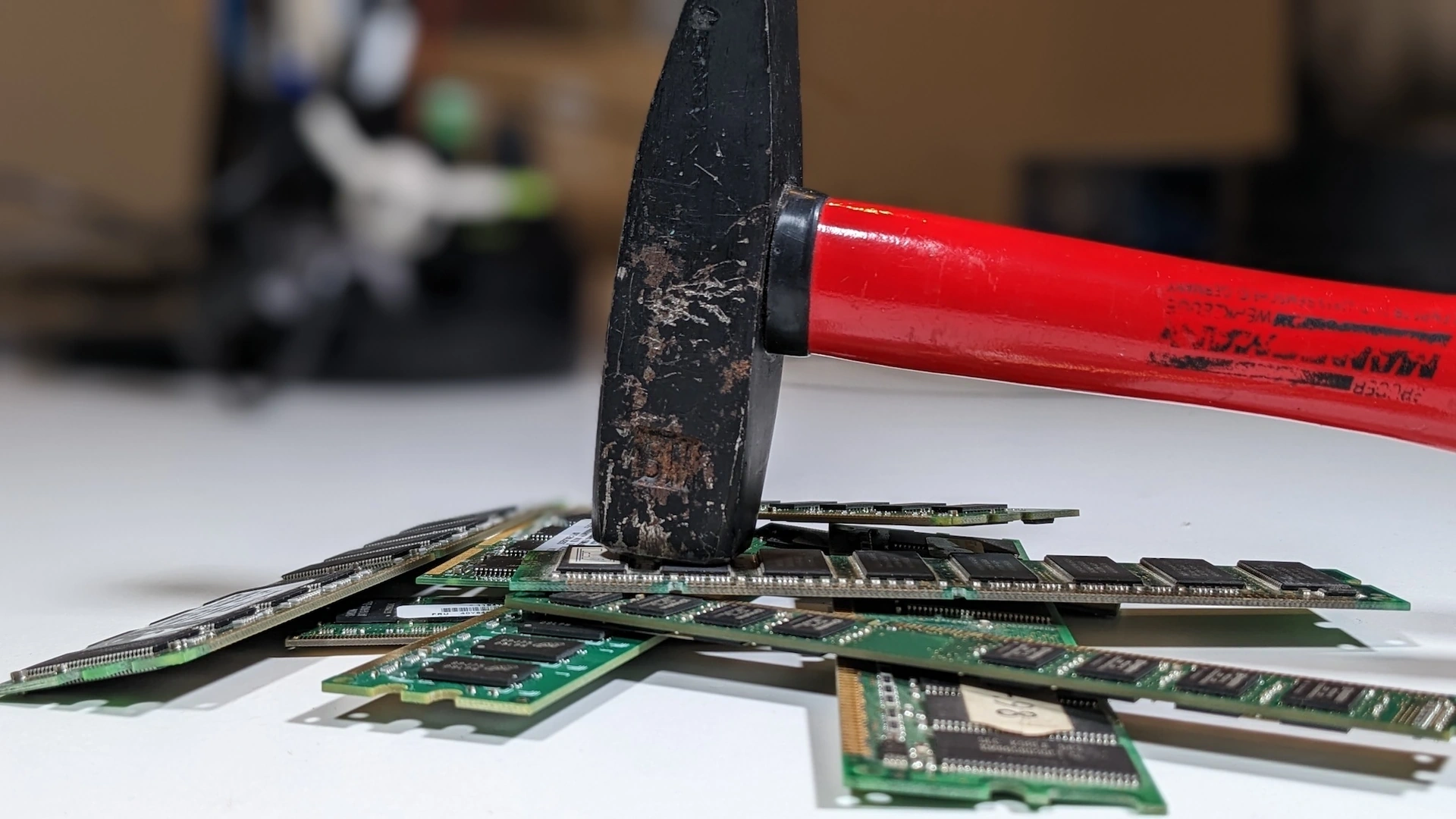
This will be a followup talk after our talk "Ten Years of Rowhammer: A Retrospect (and Path to the Future)" at 38C3. In the talk last year we gave an overview of the current state of Rowhammer and highlighted that there are no large-scale prevalence studies. We wanted to change that and asked the audience to participate in our large-scale study on Rowhammer prevalence.
We performed the large-scale study on Rowhammer prevalence thanks to many volunteers supporting our study by measuring their systems. In total, we collected 1006 datasets on 822 different systems (some systems were measured multiple times). We show that 126 of them (12.5%) are affected by Rowhammer with our fully-automated setup. This should be seen as a lower bound, since the preconditions required for effective tools failed on ~50% of the systems. Among many other insights, we learned that the fully-automated reverse-engineering of DRAM addressing functions is still an open problem and we assume the actual number of affected systems to be higher as the 12.5% we measured in our study.
Now, one year after our talk at the 38C3, we want to give an update on the current state of Rowhammer, since multiple new insights were published in the last year: The first reliable Rowhammer exploit on DDR5, a JavaScript implementation of Rowhammer that works on current DDR4 systems, and an ECC bypass on DDR4, just to name a few. Additionally, we want to present the results of our large-scale study on Rowhammer prevalence which was supported by the audience from last year's talk.
Speakers of this event

Martin Heckel

Florian Adamsky
Florian Adamsky attended the first Chaos Communication Congress in 2000 (17C3). He co-founded Chaostreff Regensburg at some point, before becoming immersed in academia, from which he has not found his way out. As a result, he has been serving as a professor of IT security at Hof University of Applied Sciences since 2019. In 2020, he established his own small research group called System and Network Security (SNS), which focuses on phishing, anonymity networks, and hardware-based side-channel attacks, such as Rowhammer.

Daniel Gruss
Daniel Gruss (@lavados) is a Professor at Graz University of Technology. He has been teaching undergraduate courses since 2010. Daniel's research focuses on side channels and transient execution attacks. He implemented the first remote fault attack running in a website, known as Rowhammer.js. His research team was one of the teams that found the Meltdown and Spectre bugs published in early 2018. He frequently speaks at top international venues.