CCC&T - Cosmic ray, the Climate Catastrophe and Trains.
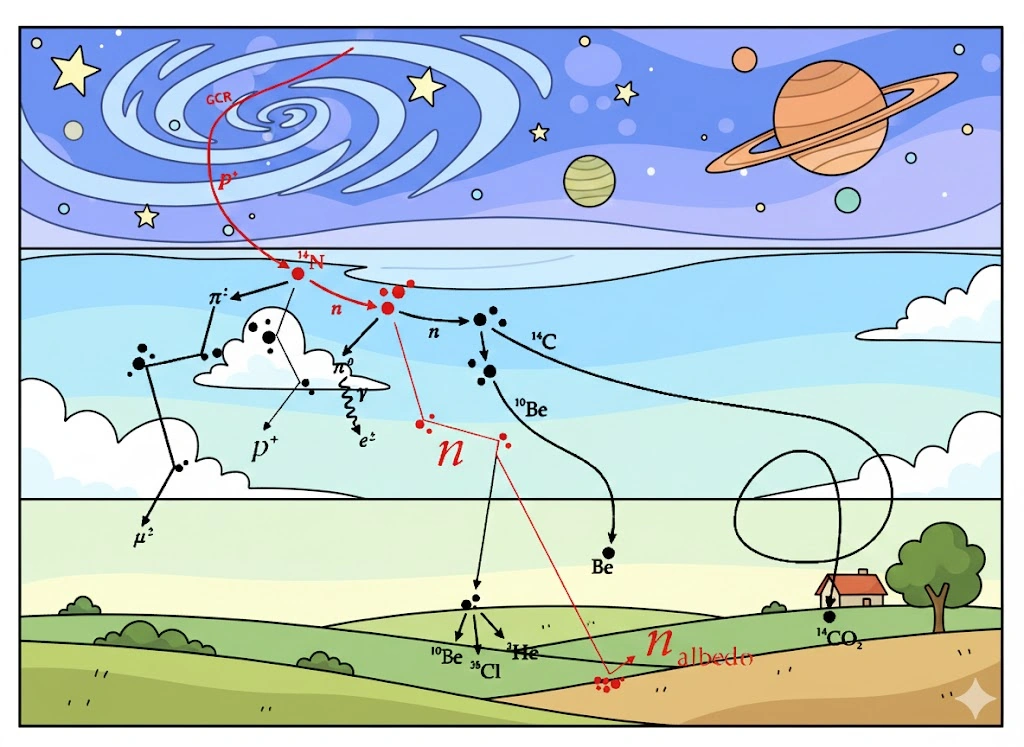
The Dürremonitor is a programme that is often mentioned in the German news when some regions experience drought. Alongside the Dürremonitor and the underlying Mesoscale Hydrological Model (MHM), there is ongoing research at the UFZ concerning soil moisture. Some of these studies involve measuring soil moisture using a technique called cosmic ray neutron sensing (CRNS). Rather than taking measurements, the MHM uses a physics-based model incorporating precipitation forecasts to predict drought or flood. These two strategies for quantifying soil moisture are therefore in opposition: the measurement-based approach (CRNS) and the modelling-based approach (MHM/Dürremonitor). CRNS is a relatively new method of measuring soil moisture based on the proportion of neutrons reflected by the soil (the principles were discovered in the 1980s, but it has only recently become commercially applicable). This method has several advantages over previous soil moisture measurement methods: it is non-invasive, easy to set up, portable and can therefore be used on trains.
In the talk I will give an overview of the Dürremonitor and MHM and then focus on CRNS. I will explain the physical principles behind the method, how it is implemented in practice by making serveys using trains.